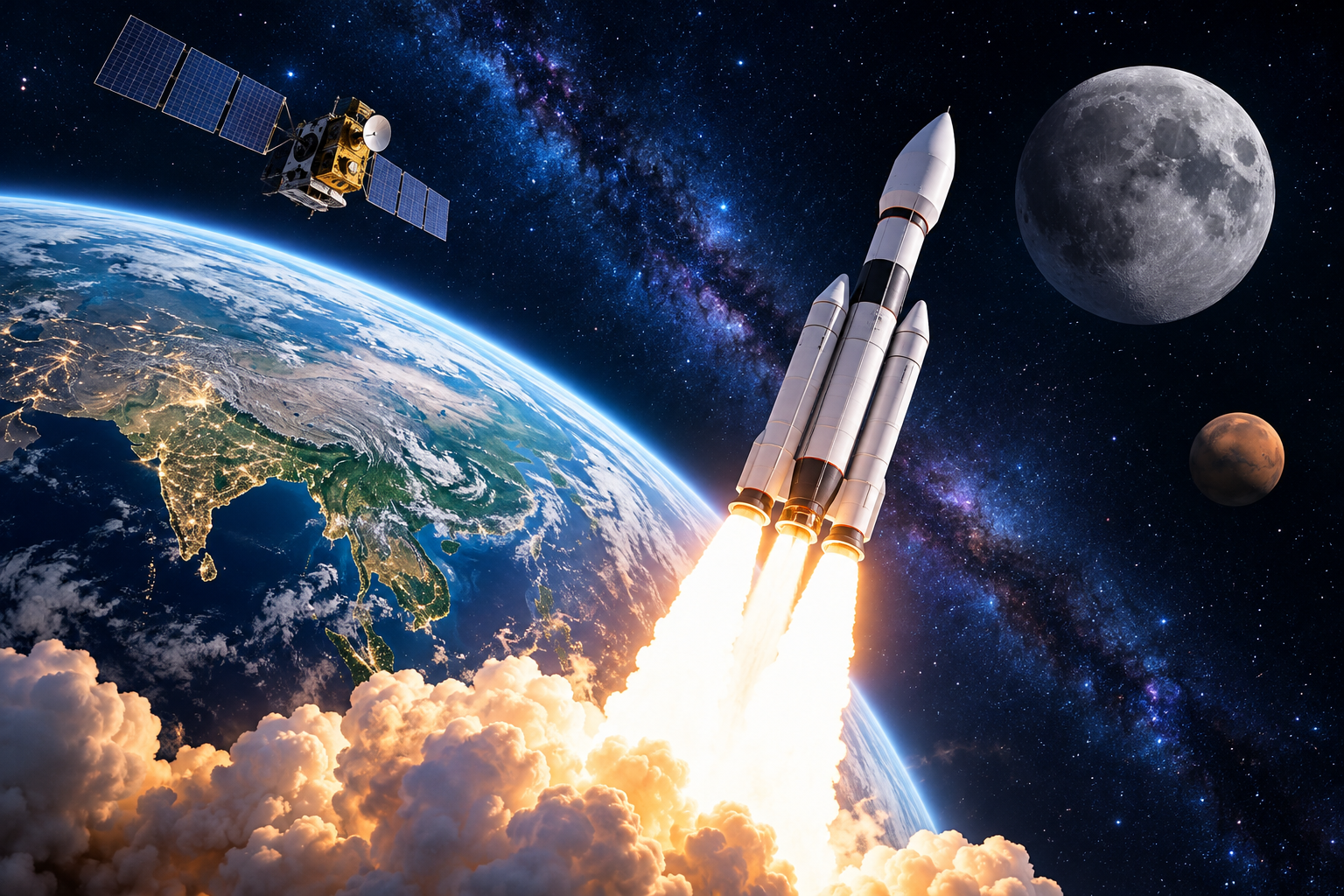
World Space Week 2026 is being observed from October 4 to October 10, 2026, under the theme “Rocket Revolution.” The annual global celebration highlights the role of space science and technology in improving life on Earth and explores how new rocket technologies are changing the future of space exploration.
World Space Week 2026: Quick Answer
| Information | Details |
|---|---|
| Dates | October 4–10, 2026 |
| Theme | Rocket Revolution |
| Celebrated by | Countries, space agencies, schools, universities and space organisations worldwide |
| India's space agency | ISRO |
| Key focus in 2026 | Rockets, launch technology, reusable systems, commercial space and new space technologies |
| Official period | October 4 to October 10 every year |
When Is World Space Week 2026?
World Space Week 2026 runs from October 4 to October 10. The dates are fixed every year and commemorate two major milestones in the history of space exploration.
- October 4: Launch of Sputnik 1 in 1957, the world's first artificial satellite.
- October 10: The Outer Space Treaty entered into force in 1967.
These two dates represent the beginning of the Space Age and the development of an international framework for the peaceful use of outer space.
What Is the Theme of World Space Week 2026?
The official theme for World Space Week 2026 is “Rocket Revolution.”
The theme focuses on the rapid development of rocket technology and how modern launch systems are making access to space more frequent, flexible and commercially viable.
The rocket industry has changed significantly from the early days of space exploration. Modern launch vehicles increasingly focus on improved efficiency, reusability, lower launch costs, private-sector participation and faster deployment of satellites.
What Does “Rocket Revolution” Mean?
“Rocket Revolution” refers to the major transformation taking place in the way spacecraft and satellites are launched into orbit.
Traditional rockets were generally designed for single-use missions. Today, space companies and agencies are developing technologies that can recover and reuse parts of launch vehicles, helping reduce costs and increase launch frequency.
The rocket revolution also includes:
- Reusable launch vehicles
- Private space companies
- Small satellite launchers
- Advanced propulsion systems
- Lower-cost access to orbit
- Commercial space launches
- Rapid satellite deployment
- New-generation launch vehicles
Why Is World Space Week 2026 Trending in India?
Interest in World Space Week is particularly relevant in India because the country's space programme has expanded significantly over the past several years.
India's space activities now cover satellite launches, lunar exploration, solar missions, human spaceflight preparations, commercial launches and the growing private space sector.
ISRO's achievements have also increased public interest in space science among students, engineers and young technology enthusiasts.
Why Does World Space Week Start on October 4?
World Space Week begins on October 4 because Sputnik 1 was launched on October 4, 1957.
Sputnik 1 was the first artificial satellite to orbit Earth. Its launch marked the beginning of the Space Age and demonstrated that humans could place an artificial object into orbit around our planet.
The achievement changed the direction of science, engineering and international competition in space exploration.
Why Does World Space Week End on October 10?
World Space Week ends on October 10 because the Outer Space Treaty entered into force on October 10, 1967.
The treaty established important principles governing activities in outer space and emphasised the peaceful use of space.
Together, October 4 and October 10 connect the technological beginning of the Space Age with the development of international space law.
World Space Week 2026 and India
India is an important participant in global space activities through the Indian Space Research Organisation (ISRO), universities, research institutions, startups and private space companies.
During World Space Week, educational institutions and space organisations can conduct exhibitions, lectures, competitions, workshops, model-making activities and astronomy-related programmes.
India's space ecosystem also gives students an opportunity to learn about careers in aerospace engineering, astronomy, satellite technology, robotics, electronics, computer science and space research.
ISRO and World Space Week
ISRO plays an important role in India's space programme and is closely associated with many of the country's major space missions.
India has developed a wide range of launch vehicles and satellite technologies, while missions such as Chandrayaan and Aditya-L1 have increased global interest in Indian space science.
World Space Week provides an opportunity to explain how India's space programme has evolved from early satellite and launch experiments to sophisticated lunar, solar and human-spaceflight missions.
From PSLV to LVM3: India's Rocket Evolution
India's launch vehicle programme has progressed through several generations of rockets.
The Polar Satellite Launch Vehicle (PSLV) became one of India's most reliable launch vehicles and has been used for a wide range of Earth-observation, navigation and scientific satellite missions.
The Launch Vehicle Mark-3 (LVM3) represents a larger and more powerful generation of Indian launch vehicles and has been used for major missions, including India's lunar exploration programme.
This evolution demonstrates how rocket technology has developed alongside India's broader space ambitions.
How the Rocket Revolution Could Change Space Exploration
The rocket revolution could make space more accessible to governments, companies, universities and research organisations.
Lower launch costs and more frequent launches could support the deployment of larger satellite constellations, scientific instruments and communication systems.
Future developments could also support more ambitious missions to the Moon, Mars and other destinations.
How Rocket Technology Affects Everyday Life
Space technology is not limited to astronauts and space agencies. Satellite systems already influence many aspects of everyday life.
- GPS and navigation
- Weather forecasting
- Telecommunications
- Television broadcasting
- Disaster management
- Agricultural monitoring
- Climate and environmental monitoring
- Mapping and geospatial services
- Internet connectivity
As launch costs decline, more satellite-based services may become possible.
World Space Week 2026 and Gaganyaan
India's human spaceflight programme, Gaganyaan, is another important part of the country's space ambitions.
The programme aims to demonstrate India's capability to send humans into low Earth orbit and safely return them to Earth.
Human spaceflight requires advanced launch vehicles, crew systems, life-support technologies, astronaut training and complex mission operations.
The development of these technologies could create opportunities for India's aerospace and engineering sectors.
Why World Space Week Matters for Students
World Space Week is particularly valuable for students because it connects classroom subjects with real-world scientific missions.
Students interested in space can explore subjects such as:
- Physics
- Mathematics
- Aerospace engineering
- Mechanical engineering
- Electronics
- Computer science
- Robotics
- Astronomy
- Earth sciences
Space exploration is also becoming increasingly interdisciplinary, combining engineering, software, artificial intelligence, materials science, biology and data analysis.
World Space Week 2026 Events for Students
Students can participate in World Space Week activities through schools, colleges, universities, astronomy clubs and space organisations.
Common activities include:
- Space science exhibitions
- Rocket model competitions
- Poster and essay competitions
- Astronomy observation sessions
- Space quizzes
- Guest lectures
- Science demonstrations
- Planetarium programmes
- Satellite and rocket workshops
- Space-themed coding and robotics activities
World Space Week Events in India
Events can be organised across different Indian cities by educational institutions, space organisations and science communities.
Students should check official announcements from participating institutions before attending an event because schedules, registration requirements and venues may vary.
World Space Week and Google Doodles
Google has previously highlighted important space-related events and scientific milestones through special search features and Doodles.
Space-related Google trends can also provide an indication of growing public interest in astronomy, rockets, satellites and space exploration.
What Is the Future of the Rocket Revolution?
The future of rocket technology is expected to focus on making space launches more efficient, affordable and frequent.
Several major areas are likely to influence the next phase of space exploration:
- Reusable launch systems
- Smaller and more efficient satellites
- Commercial launch services
- Private space stations
- Lunar exploration
- Mars missions
- Advanced propulsion
- Autonomous spacecraft
- Space-based manufacturing
- Growing participation from startups
How Can You Celebrate World Space Week 2026?
You do not need to be a scientist or engineer to participate in World Space Week.
You can celebrate by learning about India's space missions, watching educational astronomy programmes, visiting a planetarium, joining a science event, observing the night sky or reading about the history of space exploration.
Students can also build simple rocket models, participate in quizzes or create educational projects related to space science.
Why the Rocket Revolution Theme Matters
The “Rocket Revolution” theme reflects a major change in the global space industry.
Space is no longer limited to a small number of government agencies. Private companies, startups, universities and research organisations are increasingly becoming part of the space ecosystem.
More affordable launches can create new opportunities for scientific research, communications, Earth observation and commercial applications.
World Space Week 2026: Final Takeaway
World Space Week 2026 will be celebrated from October 4 to October 10 under the theme “Rocket Revolution.” The week highlights the history of space exploration while focusing on how modern rocket technology is changing access to space.
For India, the celebration is especially significant because of ISRO's expanding capabilities, India's lunar and solar missions, the Gaganyaan programme and the growth of the private space sector.
For students, World Space Week offers an opportunity to explore science, engineering, technology and future careers connected with the rapidly expanding space industry.