Planning to study MBBS abroad in 2026? Collecting the correct documents early can make the admission and visa process easier. Missing certificates, inconsistent names, expired passports or incomplete applications can cause delays, so students should prepare a checklist before applying to a foreign medical university.
The exact paperwork depends on the destination country, university, admission route and visa category. The following guide covers the documents Indian students are commonly asked to prepare and explains which requirements need official confirmation.
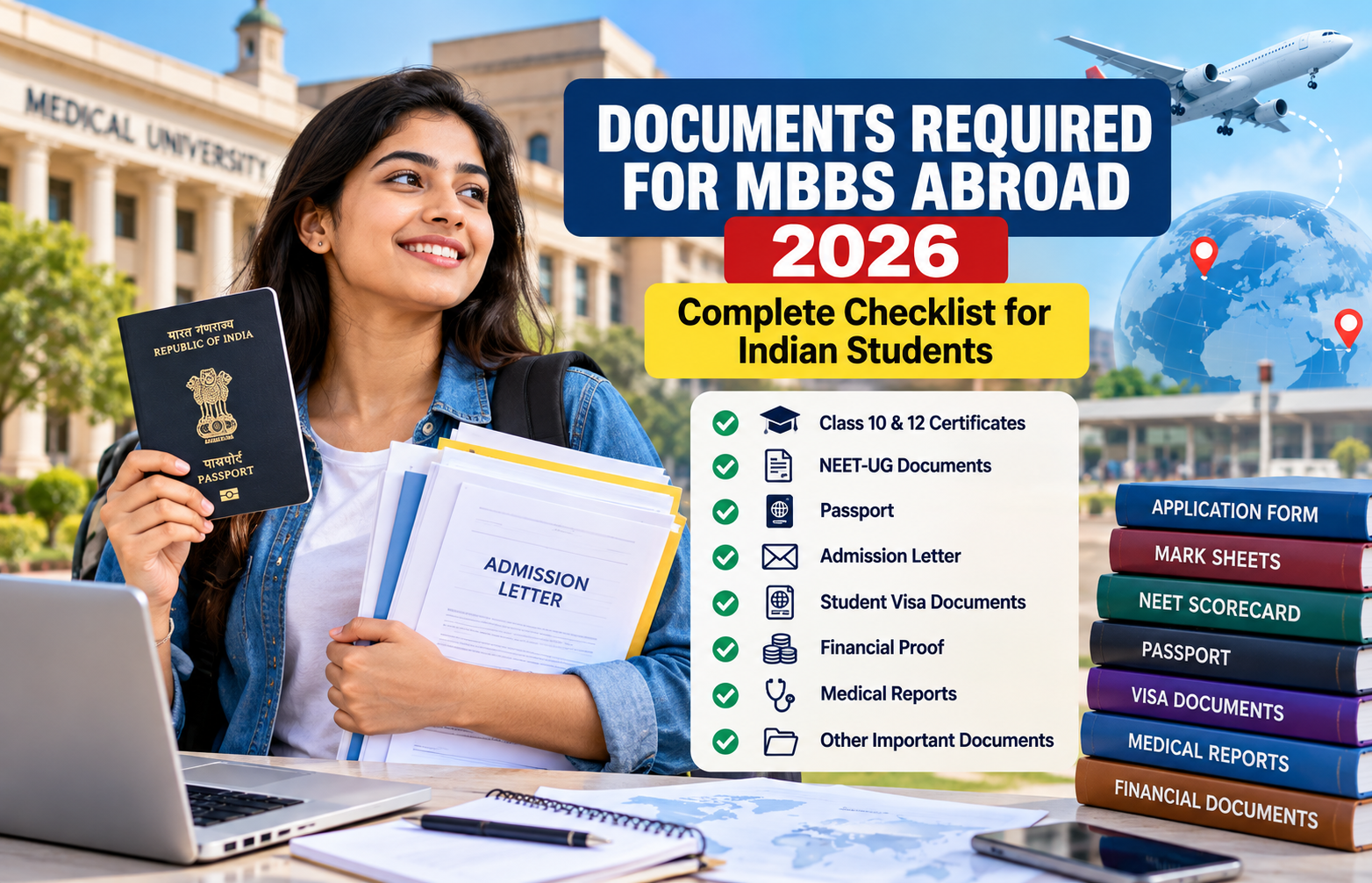
Documents Required for MBBS Abroad: Quick Checklist
- Class 10 mark sheet and passing certificate
- Class 12 mark sheet and passing certificate
- NEET-UG scorecard and related examination documents, where applicable
- Valid Indian passport
- Recent passport-size photographs in the required format
- University application form
- University offer letter or admission confirmation
- Proof of payment or fee receipt, if requested
- Birth certificate, if required
- Student visa application and supporting documents
- Medical fitness report or vaccination records, if requested
- Financial or sponsorship documents, where required
- Certified translations or authenticated documents, where required
Important: This is a general preparation checklist, not a universal official list. Ask your university for its written document requirements and check the destination country's official visa instructions.
1. Academic Documents for MBBS Abroad
Academic records help a university assess whether an applicant meets its admission criteria. Keep the original documents safe and prepare clear scans and photocopies as instructed.
Class 10 mark sheet and certificate
Universities may ask for Class 10 records to verify the student's educational history, date of birth or other personal details. Keep the certificate and mark sheet available, including any additional document needed to explain a name or date discrepancy.
Class 12 mark sheet and passing certificate
Class 12 documents are important for checking the applicant's academic background and eligibility. Students pursuing or awaiting their results should ask the university whether predicted results, provisional certificates or later submission are accepted.
Additional academic records
Depending on the institution, applicants may need school-leaving certificates, transfer certificates, migration certificates or other education records. Do not assume every university asks for all of them.
2. NEET-UG Documents for MBBS Abroad
Indian students should keep their NEET-UG scorecard and relevant examination details available when applying to overseas medical programmes.
Under applicable Indian rules, Indian citizens and other specified categories seeking admission to undergraduate medical education abroad must satisfy the relevant NEET qualification requirements. Confirm the rules applicable to your admission year and circumstances through the official National Medical Commission and examination authorities.
Useful documents to keep ready include:
- NEET-UG scorecard
- NEET application or examination details, if requested
- Any additional eligibility paperwork specified by the competent authority
Read the National Medical Commission (NMC) rules and guidance before making an admission or payment decision.
3. Passport Documents for MBBS Abroad
A valid passport is required for international travel. Students who do not yet have a passport should apply through the official Passport Seva portal.
Passport applications may require proof of date of birth, identity, residence and other supporting documents based on the applicant's circumstances. Check the current official document advisory rather than relying on an old checklist.
Before submitting university or visa applications, check that the spelling of your name and other personal details is consistent across your passport, academic certificates and admission records. If there is a mismatch, ask the university and relevant authorities how it must be resolved.
4. University Admission Documents
After selecting a university, students may be asked to submit a combination of academic, identity and application documents.
- Completed university application form
- Scanned passport and photograph
- Class 10 and Class 12 records
- NEET-UG scorecard, where applicable
- University-specific declarations or forms
- Offer letter or admission confirmation after acceptance
- Fee receipt or payment confirmation, if requested
Some universities may ask for documents in a prescribed format or language. Check the official university website and request written confirmation of any requirement that is unclear.
5. Student Visa Documents
A university admission letter does not automatically guarantee a student visa. The destination country's immigration authority or embassy determines the visa requirements.
Depending on the country and visa category, applicants may be asked for:
- Valid passport and visa application form
- University admission letter
- Photographs meeting official specifications
- Evidence of funds or financial sponsorship
- Proof of accommodation or travel arrangements, if required
- Medical examination or insurance documents, if required
- Police clearance certificate, if required
- Translations, attestations or other supporting documents specified by the authority
Do not purchase non-refundable flights or make major financial commitments based only on an agent's assurance that the visa will be approved. Follow the official visa process for your destination.
6. Financial and Sponsorship Documents
Some universities and visa authorities require evidence that the student can meet tuition, accommodation and living expenses. The exact documents and minimum financial thresholds vary by country and visa category.
Possible supporting documents include:
- Bank statements in the format and period requested by the authority
- Parent or sponsor declaration, where applicable
- Proof of relationship to the sponsor, if required
- Income or employment documents, if requested
- Scholarship letter or approved funding evidence, where applicable
- University fee receipt, if required
Use genuine financial records and follow the official instructions. Never submit altered bank statements or misleading sponsorship information.
7. Medical Fitness, Vaccination and Other Documents
Some universities or destination countries may require medical fitness reports, vaccination records, insurance documentation or other health-related paperwork. Requirements can differ significantly.
Ask the university which examinations, certificates, forms and timelines apply. Use the medical provider or format specified by the relevant authority if one is prescribed.
Students should also ask whether they need to carry original prescriptions or other personal medical records when travelling, if relevant to their circumstances.
8. Are Attestation, Apostille and Translation Required?
Not every document for every destination needs an apostille or attestation. Whether authentication or certified translation is necessary depends on the destination country's rules, the university's instructions and the type of document.
The Ministry of External Affairs explains India's attestation and apostille services for documents intended for use abroad. Check its official guidance at MEA — Attestation and Apostille before paying an intermediary.
If translation is required, confirm the accepted language, translator credentials and certification format with the university or visa authority. Keep copies of both the original document and its approved translation.
9. Important NMC Checks Before Choosing a Foreign Medical University
Document preparation is only one part of planning MBBS abroad. Indian students who intend to practise medicine in India should understand the applicable National Medical Commission requirements before enrolling.
Review the NMC rules and regulations, including the Foreign Medical Graduate Licentiate Regulations, 2021 and the latest official FAQs or clarifications.
Check the applicable requirements for the course's duration, mode of study, clinical training, internship, eligibility and the process for obtaining registration in India. Do not rely solely on a university agent's verbal promise that a degree will automatically qualify you to practise in India.
Where an eligibility certificate or other regulatory document applies to your case, confirm the current process and deadlines directly with the NMC. Regulatory procedures can change, and an old article may no longer reflect the latest instructions.
10. Country-Wise Document Requirements: Why They Differ
There is no single visa checklist that applies to every MBBS destination. One country may require financial evidence in a particular format, while another may require additional medical, translation or authentication paperwork.
Before applying, ask the university for its current international-student checklist and confirm visa requirements with the relevant embassy or official immigration portal.
| Document category | What to confirm |
|---|---|
| Academic records | Required certificates, marks, minimum grades and accepted formats |
| NEET-UG | Applicable qualification and evidence requirements |
| Passport | Validity requirements and personal-detail consistency |
| Admission | Application form, offer letter and fee-related proof |
| Visa | Official forms, financial proof and supporting paperwork |
| Authentication | Whether apostille, attestation or translation is required |
| Medical requirements | Any prescribed fitness examination, insurance or vaccination documents |
11. When Should You Prepare Your Documents?
Start collecting academic certificates and checking passport validity before submitting applications. Some documents take longer to obtain or correct, especially where names differ, records need reissue, or authentication is required.
- Before applying: Review academic eligibility, passport validity and the university's document checklist.
- During the application: Submit clear scans in the requested format and retain copies of every submission.
- After receiving an offer: Confirm fee, admission and visa paperwork directly with the university and official authorities.
- Before departure: Check original-document requirements, visa validity, accommodation arrangements and the university's arrival instructions.
12. Common Document Mistakes to Avoid
- Submitting unclear scans or incomplete pages
- Using different spellings of a name across documents without resolving the discrepancy
- Assuming a visa checklist from one country applies to another
- Paying for apostille or translation before confirming that it is needed
- Relying only on an agent's checklist instead of official instructions
- Submitting false, edited or misleading documents
- Ignoring NMC requirements when planning to practise medicine in India
- Discarding original receipts, application confirmations or university correspondence
Conclusion
The main documents required for MBBS abroad commonly include Class 10 and Class 12 records, NEET-UG paperwork where applicable, a valid passport, university admission documents and the destination country's student visa paperwork. Financial evidence, medical records, translations and authentication may also be required.
Use this checklist to prepare, but obtain the final list from your selected university and the destination country's official visa authority. If you plan to practise medicine in India after graduation, review the current NMC regulations before choosing a course or paying admission fees.
For a broader overview of country options, eligibility and costs, read our MBBS Abroad 2026 guide. Students from West Bengal can also read our MBBS Abroad guide for West Bengal students.