Every business wants to grow. But growth does not happen simply because a company runs advertisements, publishes social media posts, builds a website or starts using artificial intelligence. Sustainable growth requires the right customers, a clear offer, a reliable lead-generation process, consistent follow-up, a good customer experience and a way to measure what is working.
This is where business growth consulting becomes valuable. Rather than treating every business problem as a marketing problem, a growth-focused approach examines the entire journey—from how customers discover a business to how enquiries become sales and how customers return.
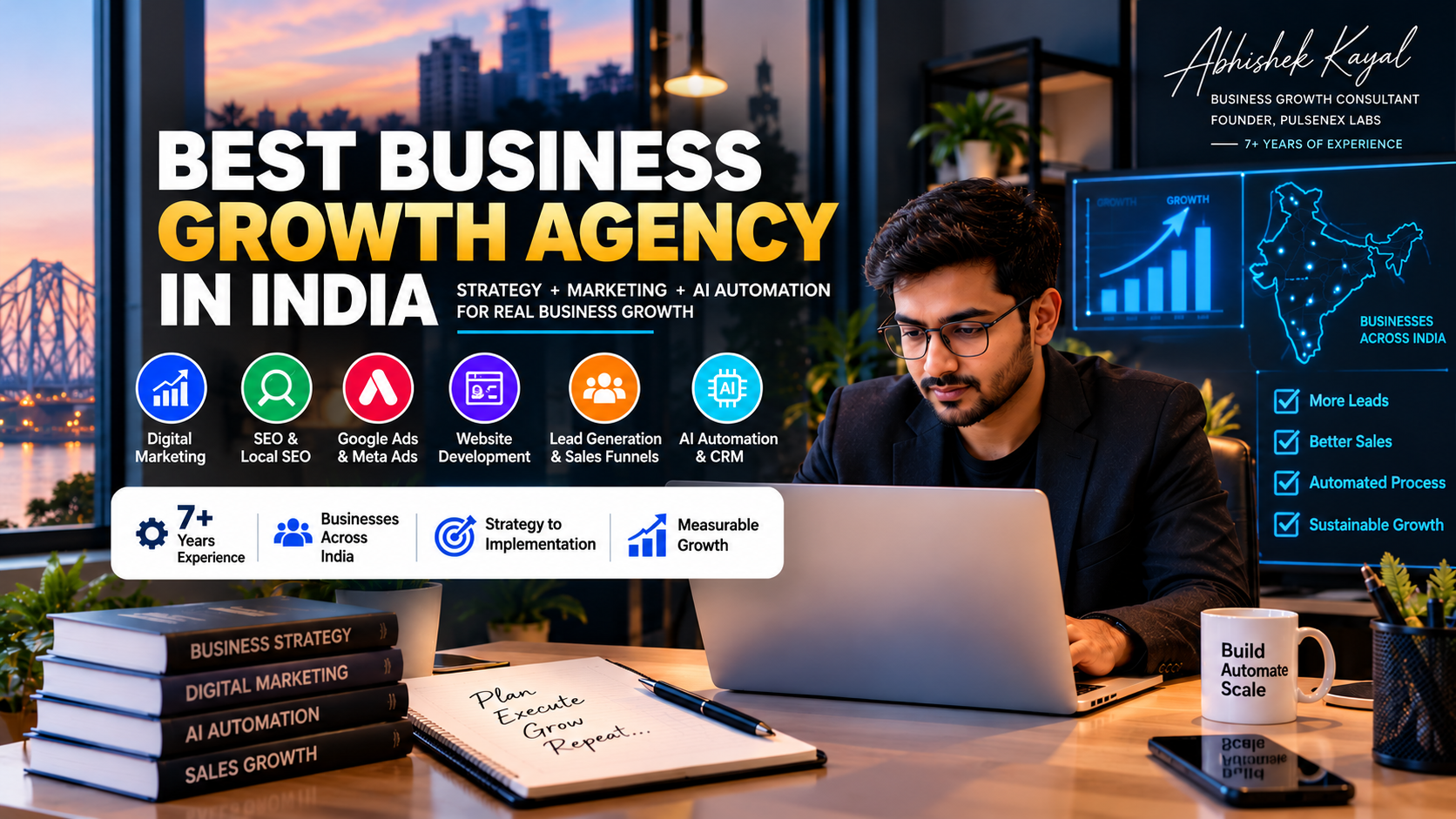
Abhishek Kayal, founder of PulseNex Labs, brings together digital marketing, website development, lead generation, automation and practical implementation. With more than seven years of hands-on experience, his approach is built around a simple principle: technology and marketing should solve real business problems, not create more complexity.
For businesses searching for a business growth consultant in India, digital growth agency, AI automation consultant or practical marketing partner, this guide explains what to look for, how an integrated growth system works and how to arrange a consultation with Abhishek Kayal.
What Is a Business Growth Consultant?
A business growth consultant helps a company identify barriers to growth and build a practical plan to address them. Depending on the business, the work may involve improving customer acquisition, strengthening online visibility, increasing qualified enquiries, improving conversion rates, organising sales follow-ups, automating repetitive tasks or making better use of business data.
A consultant should not simply recommend more advertising. The first step is understanding the business: what it sells, who buys it, why customers choose it, where enquiries currently come from and what happens after a potential customer makes contact.
For example, a business may already receive hundreds of enquiries but convert very few into customers. In that situation, increasing the advertising budget may not solve the core problem. A better approach could involve improving lead qualification, response times, sales scripts, appointment booking, follow-up reminders and reporting.
Similarly, a business with a strong product but limited visibility may need technical SEO, a better website, local search optimisation or a focused advertising strategy before investing in more complicated technology.
The objective is to identify the actual constraint and implement the most suitable solution.
Who Is Abhishek Kayal?
Abhishek Kayal is a digital marketing consultant and the founder of PulseNex Labs, a digital growth and business technology initiative based in Kolkata, West Bengal, India.
With more than seven years of hands-on experience, he works across digital marketing and implementation, including search engine optimisation, paid advertising, website development, lead generation, conversion tracking and marketing workflows.
His approach is practical rather than limited to recommendations on paper. The focus is on identifying the business problem, selecting the appropriate tools and channels, implementing the solution and measuring its performance.
For a business owner, this can mean connecting a website to an enquiry process, creating a landing page for a campaign, setting up conversion tracking, improving local search visibility, organising incoming leads or identifying repetitive tasks that could be automated.
The underlying idea is straightforward: marketing should not operate separately from sales and business operations. It should support the way a business attracts customers, handles enquiries and delivers its services.
What Makes PulseNex Labs Different?
Businesses do not always need another supplier that handles only one activity. They may need someone who can understand the wider problem and coordinate the right combination of marketing, technology and process improvement.
PulseNex Labs focuses on connecting these areas rather than treating them as unrelated services.
1. Strategy Connected to Implementation
A strategy is useful only when it can be implemented. Recommendations should consider the company's budget, team, customer behaviour, existing technology and operational capacity.
The process begins by understanding what the business is trying to achieve. The resulting plan should prioritise actions that are realistic, relevant and measurable.
2. Digital Marketing With a Business Objective
SEO, paid advertising, social media and email marketing should serve a clear purpose. Depending on the business, that purpose could be increasing qualified enquiries, generating bookings, improving product sales, attracting local customers or strengthening brand visibility.
Impressions and followers can provide useful context, but they do not automatically represent business growth. Campaigns should be evaluated using appropriate measures such as qualified leads, conversion rate, customer acquisition cost, sales and return on advertising spend when reliable data is available.
3. Websites Built to Support Conversions
A website should help visitors understand the offer, evaluate the business and take the next step. Depending on the objective, that action may be calling, requesting a quotation, booking an appointment, submitting an enquiry or purchasing a product.
Website development can be combined with landing pages, contact forms, analytics, search optimisation and lead-management workflows so that a website functions as part of the business's customer acquisition system.
4. AI Automation Applied to Real Work
AI is most useful when it solves a defined problem. A business might use automation to acknowledge enquiries, categorise incoming leads, send permitted reminders, organise information, support customer service or reduce repetitive administrative work.
Not every task requires AI. A simple rule-based workflow may be more reliable and economical than an advanced AI system. The right approach depends on the task, risk, data quality, customer expectations and cost of implementation.
5. A Focus on Visibility and Measurement
Businesses should be able to understand what work is being done, what it costs and what the available data shows. Suitable reporting may include search performance, website enquiries, advertising spend, conversion events, lead status and sales outcomes.
Measurement helps a business distinguish activity from progress and make better decisions about where to invest next.
Business Growth Services Offered Through PulseNex Labs
The services below can be combined according to a business's requirements. Not every company needs every service, and the recommended scope should be based on its goals and current situation.
Search Engine Optimisation and Local SEO
SEO helps businesses become more discoverable when potential customers search for relevant products, services or solutions. Work may include technical website audits, site structure, on-page optimisation, useful content, internal linking, local SEO and Google Business Profile management.
For a local service provider, the focus may be relevant searches in its service area. For a national business, the strategy may involve broader commercial keywords, product or service pages and content that answers customer questions.
SEO is a long-term process. Rankings depend on competition, website quality, search intent, authority and many other factors. No responsible consultant can guarantee a specific Google position or a fixed timeframe for ranking.
Google Ads and Meta Ads
Paid advertising can help a business reach relevant audiences while its organic visibility develops. Google Ads can target people searching for particular services, while Meta Ads can introduce offers to selected audiences and support lead generation, retargeting and customer acquisition.
Campaign planning should consider the offer, audience, landing page, budget, tracking setup and the team's ability to handle incoming leads. The goal is not simply to generate the largest possible number of enquiries; it is to attract enquiries that the business can serve and convert profitably.
Performance should be reviewed using appropriate data, including cost per qualified lead, conversion rate and sales outcomes wherever those measurements can be tracked reliably.
Website Development and Landing Pages
A business website should communicate the value of the business clearly and make the next step easy. Depending on the project, this may include WordPress development, custom-coded pages, service pages, lead forms, landing pages, e-commerce features or integrations with other business tools.
Website work can also include mobile usability, page speed, technical SEO, analytics and conversion tracking. These elements help the business understand how visitors interact with its website and where improvements may be needed.
Lead Generation and Sales Funnels
Lead generation is not complete when a person submits a form. A useful funnel connects the initial enquiry to the next action, such as a call, consultation, demonstration, appointment or purchase.
A practical funnel may include a targeted landing page, a clear offer, an enquiry form, lead categorisation, a follow-up process, appointment scheduling and reporting. The structure should reflect how the business actually sells.
For businesses with longer sales cycles, the process may also include lead nurturing, scheduled follow-ups and a way to record why enquiries progress or drop off.
CRM and Customer Follow-Up
When enquiries are scattered across phone calls, spreadsheets, social media and messaging apps, businesses can lose track of potential customers. A customer relationship management system can centralise the information needed to manage those enquiries.
Depending on the requirements, a CRM workflow may track the source of a lead, assigned team member, enquiry status, next follow-up date, appointment, sale and customer history.
Automation can support reminders and routine updates, while staff remain responsible for meaningful conversations, negotiations and decisions that require human judgement.
WhatsApp and Marketing Automation
Messaging automation can help businesses respond more consistently and manage repetitive communication. Potential use cases include enquiry acknowledgements, appointment reminders, order updates, customer support routing and follow-up sequences.
Implementation should use appropriate platforms and comply with applicable messaging policies, consent requirements and data-protection obligations. Automated messages should be relevant and respectful rather than excessive or unsolicited.
Social Media and Content Marketing
Social media should do more than keep an account active. Content can explain a service, answer common questions, demonstrate expertise, address objections and help potential customers decide whether a business is right for them.
A practical content plan connects topics to the audience's needs and the company's commercial objectives. Content performance should be reviewed alongside meaningful actions such as profile visits, website traffic, enquiries and conversions where measurable.
Analytics and Conversion Tracking
Marketing decisions become more useful when a business can see which channels generate enquiries and which enquiries turn into customers. Depending on the setup, analytics may cover website events, advertising conversions, campaign sources, lead status and sales outcomes.
Tracking must be implemented correctly. A form submission, a phone click and a completed sale are different events and should not be treated as interchangeable conversions.
How AI Automation Can Help a Real Business Grow
AI automation is often presented as a shortcut to business success. In practice, its value depends on the process it improves.
Consider a business that receives enquiries from its website, advertisements and WhatsApp. If staff manually copy information into different spreadsheets, forget follow-ups or struggle to identify urgent enquiries, the problem is not necessarily a lack of advertising. It may be a lack of a connected process.
A carefully designed workflow could capture an enquiry, store its details, identify the source, assign it to the appropriate team member and create a follow-up reminder. Where suitable, AI could help classify the enquiry or draft a response for staff review.
The business could then monitor how many enquiries were received, how quickly the team responded, how many appointments were booked and how many opportunities converted into customers.
This is the practical side of AI: connecting technology to a measurable operational need.
Examples of Practical Automation
- Clinics and service businesses: Enquiry capture, appointment requests, reminders and follow-up tracking.
- Educational consultancies: Student enquiry management, counselling appointments, application status and lead follow-ups.
- E-commerce businesses: Order notifications, customer support routing, inventory alerts and repeat-purchase communication.
- Local businesses: Website enquiries, call tracking, customer databases, review requests where permitted and quotation follow-ups.
- Sales teams: Lead assignment, task reminders, pipeline reporting and standardised status updates.
These are examples of possible implementations, not a claim that every system is automatically available in every package. The scope, integrations, platform costs and feasibility should be assessed before work begins.
A Practical 90-Day Business Growth Framework
There is no universal 90-day formula that guarantees growth. However, a phased plan can help a business move from scattered activity to a more organised process.
Days 1–30: Understand and Fix the Foundations
- Understand the business model, target customers and commercial objectives.
- Review the website, search visibility, advertising, social channels and existing enquiry process.
- Identify the main barriers to customer acquisition or conversion.
- Check analytics, conversion tracking and lead records.
- Prioritise the most important fixes based on impact, effort and budget.
Days 31–60: Implement the Priority Growth System
- Improve relevant website pages or landing pages.
- Implement the selected SEO, advertising or content priorities.
- Connect enquiry capture to a practical lead-management process.
- Introduce suitable follow-up reminders or automation.
- Test the customer journey from the first click or enquiry to the next sales action.
Days 61–90: Measure, Learn and Improve
- Review lead quality and conversion data.
- Identify where customers drop out of the journey.
- Improve advertising, landing pages, messaging or follow-up where the data supports a change.
- Review spending against the business's objectives.
- Build the next phase of work around what has been learned.
The actual pace depends on the business, available data, budget, approval process and technical requirements. A 90-day roadmap is a planning framework, not a promise of a specific revenue increase.
Who Can Benefit from Business Growth Consulting?
Startups
Startups may need to validate their offer, build a credible online presence, reach an initial audience and establish a repeatable process for acquiring customers.
Small and Medium-Sized Businesses
Established businesses may need to improve local visibility, organise lead handling, make advertising more measurable or reduce manual work as enquiry volumes increase.
Clinics and Healthcare Service Businesses
Depending on their requirements and applicable regulations, clinics may benefit from local SEO, service pages, appointment enquiry management and appropriate reminder workflows. Sensitive patient information must be handled carefully and only through suitable systems.
Educational Consultants and Training Businesses
Education businesses often manage enquiries that require counselling, follow-up, document collection and application tracking. A structured lead process can help teams understand which enquiries need attention and what action is due next.
Retail and E-commerce Businesses
Retailers may benefit from product discovery, local marketing, e-commerce development, order management and customer communication. The right combination depends on their product range, fulfilment process and customer base.
Professional Services and B2B Companies
Consultants, agencies and B2B providers may need clearer service positioning, high-intent content, enquiry qualification, sales pipeline tracking and consistent follow-up.
How to Choose the Best Business Growth Agency in India
The best agency for a business is not necessarily the largest, most expensive or most heavily advertised. It is the partner whose capabilities, working method and proposed scope match the business's actual needs.
Before hiring a consultant or agency, consider the following questions:
- Do they understand your business? They should ask about your customers, offer, sales process, competition and constraints before recommending a solution.
- Can they explain implementation? You should understand what will be done, who will do it, what access is required and what the deliverables will be.
- Can results be measured? Ask which metrics matter and how they will be tracked. Beware of guaranteed rankings, leads or revenue without a sound basis.
- Do they understand the full customer journey? Generating an enquiry is only one part of growth. Ask how lead handling and conversion will be considered.
- Are costs transparent? Clarify professional fees, advertising spend, software subscriptions, third-party charges and maintenance costs.
- Will you retain control? Understand who owns the website, advertising accounts, customer data, domains and other business assets.
- Is automation appropriate? The agency should explain the problem an automation solves, its limitations and how it will be maintained.
These criteria are more useful than choosing a provider solely because it describes itself as the best agency in India.
Why Work with Abhishek Kayal and PulseNex Labs?
PulseNex Labs brings together marketing and business technology so that a business can assess its requirements in one conversation rather than starting with disconnected recommendations from several providers.
The approach is based on understanding the business first, prioritising practical work, implementing the agreed solution and reviewing the available performance data.
- Hands-on experience: More than seven years of experience in digital marketing and practical implementation, as stated by Abhishek Kayal.
- Connected capabilities: SEO, paid advertising, websites, lead generation, tracking and suitable automation can be considered together.
- Business-specific planning: Recommendations should reflect the company's target market, sales process, budget and available team.
- Practical implementation: The focus is on turning an agreed plan into working pages, campaigns, tracking or workflows.
- Transparent measurement: Progress should be assessed using relevant metrics and the data available, rather than unsupported promises.
No single approach is right for every business. The objective of an initial discussion is to determine whether PulseNex Labs is the right fit and what work would be most useful.
Book a Business Growth Consultation with Abhishek Kayal
If your business is struggling to generate qualified enquiries, improve online visibility, organise lead follow-ups, connect marketing with sales or identify practical AI automation opportunities, arrange a conversation to discuss the problem.
The first step is to explain what your business does, who your customers are, what you have already tried and what you want to improve. This helps establish whether the next step should be a marketing audit, website improvement, advertising plan, lead-management workflow or a broader growth roadmap.
Contact Details
Consultant: Abhishek Kayal
Business: PulseNex Labs
Phone / Appointment enquiries: 8895860959
Email: dms26b6abhishekk@alumni.iimidr.ac.in
Location: Kolkata, West Bengal, India
Service area: Businesses across India
To make your enquiry useful, include: your business name, industry, website or social profile if available, main growth challenge, target customers and the outcome you want to achieve.
Contact Abhishek to discuss your business goals and determine the most practical next step. Any proposed scope, timeline, fees and deliverables should be agreed before work begins.
Frequently Asked Questions
Who is a business growth consultant in India?
A business growth consultant helps companies identify barriers to customer acquisition, conversion and operations, then develops and implements suitable improvements. Abhishek Kayal of PulseNex Labs focuses on digital marketing, websites, lead generation, tracking and practical automation.
How can I contact Abhishek Kayal for a business consultation?
You can call 8895860959 or email dms26b6abhishekk@alumni.iimidr.ac.in to discuss an appointment and your business requirements.
Does PulseNex Labs help with AI automation?
PulseNex Labs' business technology offering includes CRM and automation solutions. Possible projects include lead routing, follow-up reminders, appointment workflows and customer communication, subject to the business's requirements and the feasibility of the selected platforms.
Can a business growth consultant help a small business?
Yes. Small businesses may benefit from improvements to local search visibility, website conversion, lead tracking, advertising and customer follow-up. The right priorities depend on the business's budget and growth objectives.
Does SEO guarantee first-page Google rankings?
No. SEO can improve a website's technical quality, relevance and search visibility, but Google rankings depend on multiple factors and cannot be guaranteed by a consultant.
How long does a business growth strategy take to work?
The timeframe depends on the starting position, competition, sales cycle, budget, implementation speed and chosen channels. Some technical fixes can be implemented quickly, while SEO, brand development and sustainable growth require ongoing work.
Final Thoughts: Build a Growth System, Not Just More Marketing Activity
Business growth is rarely solved by one advertisement, one social media campaign or one AI tool. It requires a clear offer, relevant customer acquisition, a reliable way to handle enquiries, a good customer experience and a process for learning from results.
Abhishek Kayal and PulseNex Labs bring together digital marketing, website development, lead generation and business automation to help companies explore these connected opportunities. The focus is on practical implementation, appropriate technology and measurable business objectives—not promises of overnight success.
If you want to discuss your company's growth challenges, contact Abhishek Kayal at 8895860959 or dms26b6abhishekk@alumni.iimidr.ac.in to enquire about an appointment.
Editorial disclosure: This is a business profile and service overview based on information supplied by Abhishek Kayal and PulseNex Labs. Service scope, availability and deliverables should be confirmed directly before engagement.